

The March 2026 stats are officially in, and if you’ve been tracking the GTA housing market, things just got very interesting. We’re seeing a classic "market tightening." In plain English? More people are buying, but fewer people are listing their homes for sale.
If you’re looking to buy or sell this spring, here is the breakdown of the numbers you need to know, the trends to watch, and why "negotiating power" is the theme of the month in every neighbourhood across the region.
The March 2026 Snapshot: By the Numbers
The market saw a notable shift in momentum as we hit the spring season. While activity is picking up, prices haven't caught up to the demand yet—creating a unique window for savvy movers.
Total Sales: 5,039 (Up 1.7% vs. March 2025).
New Listings: 14,442 (Down 16.7% vs. March 2025).
Average Selling Price: $1,017,796 (Down 6.7% vs. March 2025).
MLS® HPI Composite Benchmark: Down 7.4% year-over-year.
Why the Market is "Tightening"
Even though the number of homes for sale dropped significantly (down nearly 17%), sales actually went up. On a seasonally adjusted basis, March sales grew at a faster monthly rate than new listings compared to February.
Improved affordability is the main driver here. GTA households are finally feeling confident enough to take advantage of lower price points compared to previous years. There is a sense that as trade and geopolitical issues stabilize, consumer confidence will only continue to grow.
Price Breakdown: What’s Happening in Your Segment?
Not all home types are moving the same way. Whether you're looking for a detached house in the "905" or a condo in the "416," here is where the prices landed in March:
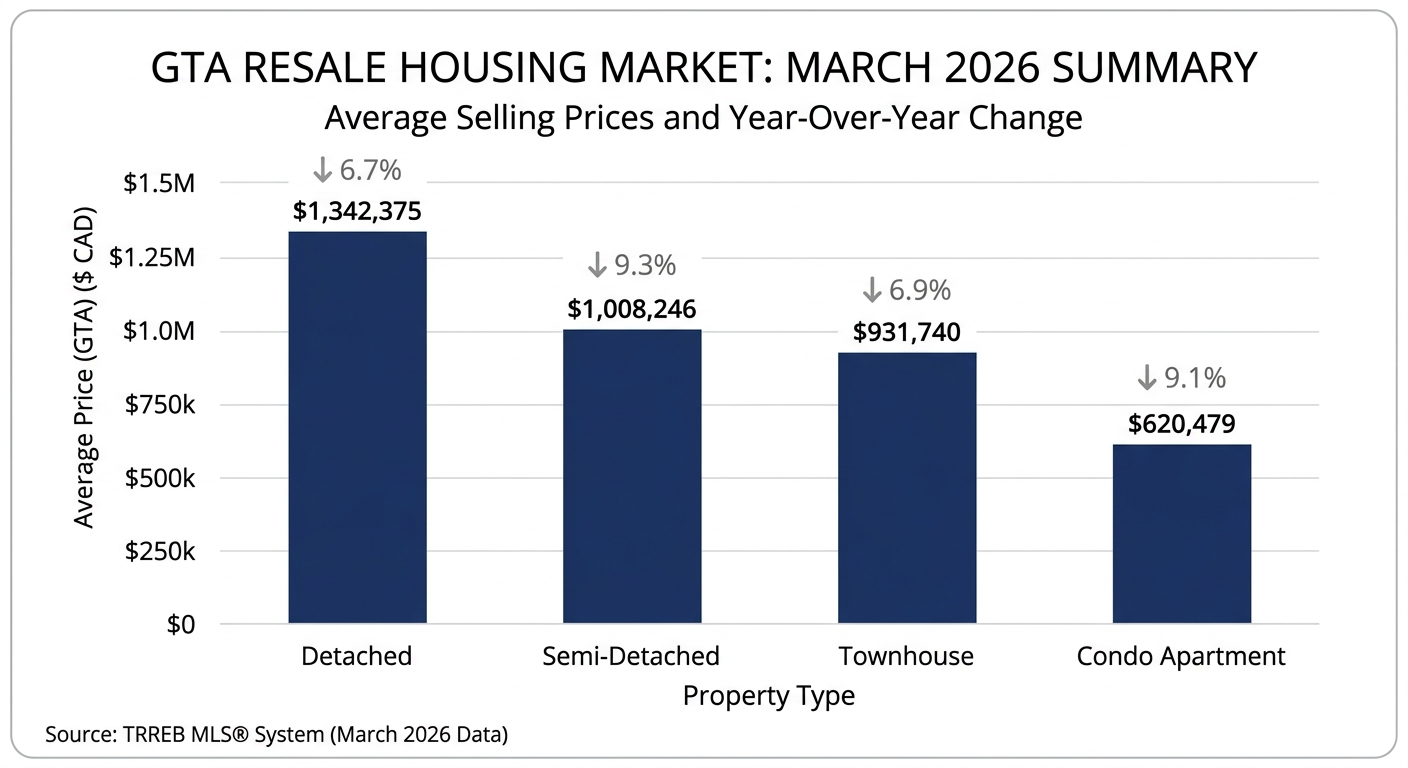
The "905" vs. The "416"
City of Toronto (416): Detached homes averaged $1,613,066, while condos stayed more accessible at $648,287.
GTA Suburbs (905): You’ll find more room for your budget here, with detached homes averaging $1,248,832 and condos at $564,332.
The Buyer’s Advantage: Negotiating Power
Right now, buyers still hold substantial negotiating power. This explains why average prices are still down year-over-year despite the fact that more people are shopping.
However, a word of caution: if this tightening trend continues throughout the spring, that leverage might vanish. If supply stays low and buyers keep coming back, prices will likely stop falling and start to level off—or even climb—later in 2026.
Looking Ahead: The "Missing Middle"
A major long-term factor for our market is the supply pipeline. While recent government moves like HST and development charge relief are helpful, there is a massive need for the "missing middle." We need more townhouses and multi-unit options to bridge the gap between high-rise condos and traditional single-family homes. The Ontario Building Homes and Improving Transportation Infrastructure Act aims to help this, but the actual construction takes time.
Final Thoughts for Your Marketing Plan
If you’re currently working on your 2026 marketing plan for real estate, the narrative is clear: Opportunity.
For Buyers: You have lower prices and more leverage than you did last year.
For Sellers: Competition is low (listings are down 16.7%), meaning your home will stand out more in a "tight" market.
Are you ready to see what these numbers mean for your specific neighbourhood? Give me call!
From Loan to Home — Your Trusted Path to Ownership. 🏡